25 April 2026
Dr. Google, Dr. ChatGPT and Reality in Clinical Practice

Why internet research cannot replace medical consultation
Quick summary for fast readers: More and more people ask Google and ChatGPT for medical advice. For initial orientation, this can be useful. However, digital systems cannot replace medical consultation. They collect existing online information and summarize it. They cannot provide a meaningful medical assessment of an individual situation.
Call the practice? Or quickly ask AI?
A scenario from daily practice that is not uncommon: A patient receives PRP treatment, for example for hair loss therapy. After treatment, we discuss behavior and potential medication for pain or swelling. Under certain conditions, a temporary anti-inflammatory pain medication can be appropriate.
The next day, the patient sends us a message: ChatGPT said the medication was not suitable after PRP treatment or suggested a different sequence (Sculptra/Morpheus8) or treatment combination. The patient is now uncertain.
Situations like this occur more and more often for us and our medical colleagues. Patients compare recommendations from clinical practice with answers from search engines or AI systems. This is understandable, because medical information is now only one click away.
The challenge: the real situation is much more complex than it appears at first glance (or click).
What Google and ChatGPT can actually do:
Digital systems can search and summarize huge amounts of information in a very short time. That is their strength.
If someone wants a quick overview of
- what PRP is in principle
- how treatment generally works
- which side effects are common
- which substances have anti-inflammatory effects
they can receive understandable information within seconds.
At its core, “Dr. ChatGPT” works like a very fast summarizer: the system accesses information available online, combines it, and formulates an answer. For general medical background knowledge or an initial introduction before a doctor's appointment, that can be useful.
What AI cannot do:
Medicine is complex and always individual. Context, practical experience, and many other factors play a role. Even the best AI-guided advice cannot provide or replace these aspects.
Search engines (including AI systems) do not see:
- the specific patient
- their pre-existing conditions and current status
- the treatment course
- the individual healing response
- in short: the actual clinical findings
Why no algorithm can fully decide here: medicine is almost never about a single concrete answer. It is about evaluating several factors at the same time.
A common anti-inflammatory medication is a good example. In some cases it is discouraged because it may influence regenerative processes. In other situations it can be helpful, for example when anti-inflammatory or decongestant effects are desired, or when pain should be reduced.
So the decision always depends on context: in which situation, for which specific patient, and after which treatment?
Internet knowledge is still not a medical degree
Medical training and clinical practice are not only about factual knowledge. What matters is interpretation in context.
A physician evaluates symptoms, tissue, history, medication, progression, and personal factors in parallel. These influence each other and must be integrated into a complex overall assessment.
Digital systems rely on existing online text and produce condensed answers. The output can sound convincing because it is well written. However, it remains a synthesis of existing content and not a medical diagnosis.
Another issue: online content keeps changing
One aspect is often underestimated: a large portion of health information online is now AI-generated itself.
Many websites are created automatically, receive little editorial or medical review, and resemble each other strongly. Texts repeat the same statements in slightly different forms.
Search engines and AI systems then rely on exactly these contents. This can create a cycle of similar, sometimes superficial, and in the worst case incorrect information.
Individual consultation remains essential
Medical decisions are the result of expertise, experience, examination, and personal assessment.
In aesthetic medicine, for example, factors include:
- the current skin condition
- overall skin quality
- tissue behavior and elasticity
- individual wound healing and scar formation
- skin response to combined treatments
This list can be expanded significantly and varies by region and from patient to patient.
Our advice to patients
We understand the desire for quick research. People who inform themselves usually make more conscious decisions.
Our recommendation remains: do your research, but treat the results as initial orientation only.
If you have follow-up or specific questions, call our practice. A short conversation often clarifies more than ten websites.
Frequently asked questions
Can I use Google or ChatGPT to prepare for medical decisions?
Yes, for initial orientation. For individual decisions, this is not enough because search engines and AI systems do not know your concrete findings, pre-existing conditions, or treatment course.
Why can AI answers differ from recommendations in practice?
Because medical decisions depend on the individual case. In practice, several factors are assessed simultaneously, such as healing course, tissue behavior, and accompanying medication.
What matters regarding medication after PRP or combined treatments?
The decision always depends on context: the patient, the treatment, and the intended outcome. Therefore, medication questions should be clarified directly with a physician.
Is online medical information reliable?
Partly. Many online texts are now automatically generated and not always medically reviewed. This can lead to very similar and sometimes superficial statements.
What is the best approach if I am uncertain?
Use online research as a starting point and clarify concrete questions directly with the practice team. A short follow-up call usually provides the safest and most individual recommendation.
Über den Autor
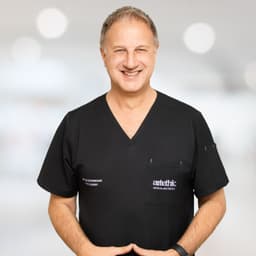
Facharzt für Plastische und Ästhetische Chirurgie & Handchirurg
Mit mehr als 30.000 Eingriffen und mehrjähriger Tätigkeit als Chefarzt führt Dr. Schuhmann seit 2016 als Gründer von artethic® seine Praxen in Düsseldorf und Berlin.