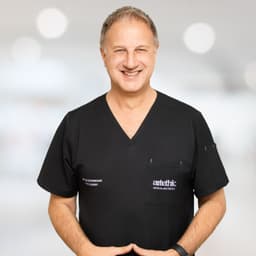
Three decades of plastic surgery and more than 30,000 procedures: what remains, what changes?
The most important principles have remained constant: care, humility and the knowledge that every procedure is more than a technical correction. What has changed significantly, however, is the environment: technologies, expectations, the influence of social media.
Constant Principles vs. Change
✓ What remains:
- • Care and humility
- • Patient wellbeing at the forefront
- • Realistic patient education
→ What is changing:
- • New technologies (RF, SMAS)
- • Social media influence
- • Changing expectations
Some developments make treatments safer and more effective. I am thinking of the SMAS facelift or regenerative treatments such as radiofrequency, with which we can essentially renew the skin from within. Or indeed novel biostimulators.
Other developments place patients under enormous pressure. More than ever, comprehensive and absolutely realistic patient education is important today. About the possibilities, but also the limitations of certain treatments. Not everything that is seen on social media or in sensationalist television programmes is achievable, realistic or even advisable.
In a world full of filters and facetuning, how does this affect your medical practice?
I am increasingly seeing patients who compare themselves to digital ideals – and not to themselves. We have many conversations about what is realistic, naturally aesthetic and what is healthy.
"Sometimes a doctor's attitude is more important than a doctor's action. And sometimes we do advise against a procedure in our practice."
When do you consciously say: "I will not operate on that"?
When I sense that the expectation is meant to compensate for something that actually lies within. When someone wants a procedure to please someone else. Or when what would be technically feasible would disfigure the face.
Naturalness takes precedence over feasibility for us. This applies not only to surgical procedures, but also to minimally invasive treatments.
What does "naturally beautiful" mean to you, also with regard to modern techniques such as exosomes, PRP or minimally invasive facelifts?
For me, it is above all about preserving individual radiance rather than concealing it. Treatments such as PRP, polynucleotides, exosomes or certain skin boosters give us the means to truly regenerate the skin, not merely tighten it.
The goal should always be for my patients to feel comfortable in their own skin again, to look fresher and healthier, not like someone else.
You have helped many people whose stories are not seen on Instagram, such as those affected by acid attacks or war injuries. What stands out most in your memory?
During the collaborative missions with several specialist doctors from various disciplines in India, Armenia or for Interplast Germany, it is not about aesthetics, but about function:
Hands that can move again
Scars that no longer cause pain
Children learning to speak again after cleft lip and palate repair
These impressions speak for themselves.
Many patients report greater self-confidence after an aesthetic treatment. How do you view this psychological effect?
An aesthetic treatment can be a step towards inner equilibrium. When someone looks more alert after an eyelid lift and feels that way too, that is not superficiality but an improvement in quality of life.
What matters is: the decision must come from one's own wish, not from the expectations of others.
You also practise internationally as a doctor. What significance does your international licence hold?
I am licensed as a plastic and aesthetic surgeon in Germany, Switzerland and Dubai. This allows me to practise medicine, provide consultations and perform surgery there as well. I therefore also have patients internationally, independently of our practice location.
You are also a specialist training supervisor, professional author and conference speaker. What role do these activities play for you?
Part of my professional career has also taken place outside the operating theatre. In lecture theatres, at conferences, in professional exchange with colleagues. As chief of a teaching hospital in NRW with academic status, I trained approximately 20 trainee specialist doctors each year. And we are currently training specialist doctors at our practice in Düsseldorf as well.
Academic Activities
I have given presentations at many conferences, presented methods and discussed surgical techniques. In Germany and internationally. And then there is the writing of specialist articles on facelift techniques, new approaches and critical questions in aesthetic medicine: More than 30,000 procedures – that is approximately my tally – means experience. Passing on this knowledge is at least equally central. I hope it contributes to keeping aesthetic medicine professionally grounded.
You also work as a medical expert witness. How does this influence your surgical practice?
As an expert witness, I see what can go wrong: incorrect indications, unrealistic expectations, inadequate patient education. Sometimes it is a clear treatment error, sometimes a tragic chain of events.
The responsibility does not lie with the doctor alone. Patients today must navigate an oversupply of options and are well advised to ask critical questions.
Treatment does not begin in the operating theatre, but in the consultation. And with thorough patient education.
You now run a larger practice with several specialist doctors. What does the team mean to you?
A great deal. All colleagues are specialist doctors in plastic and aesthetic surgery, with their own areas of focus such as transgender surgery or lip aesthetics. This broadens the range and relieves the pressure on me personally, without us making any compromises on quality.
I only employ doctors I would be happy to be treated by myself. The chemistry is right both professionally and personally. And in the best sense of the phrase, we speak the same language. That is, we know where the medical boundaries lie and that honest consultation must come before good results.
Is there a story that has moved you particularly?
Many. A patient came to me after an unsuccessful procedure that had destroyed her self-esteem. We corrected the result over several months. Carefully, in several stages.
At the end she said: "I can finally see myself again."