Kris Jenner and the “Slipped” Facelift: What a Lifting Really Can Do
At a glance
- •Honeymoon phase: early pictures never show the final result.
- •Modern facelifts fix the deep tissue layers – they don’t simply slip.
- •A second or third lift usually lasts less long than the first procedure.
- •A facelift does not replace lost volume – fat or biostimulators complement it.
- •Deep plane vs. SMAS: both reposition the deeper supporting structure.
- •Individual consultation is essential – every face needs its own plan.
In short
Kris Jenner's case shows how quickly a facelift is judged – and often misinterpreted – in public. What a lifting can really achieve depends on technique, skin quality, volume distribution, prior treatments and a realistic expectation.
First Kris Jenner’s facelift was celebrated. Now there are reports that the result has “slipped.” An insider is said to have claimed that the 70-year-old is unhappy and considering a revision. Whether that is actually true? The media don’t really know either. What is certain: the case once again shows how big the gap can be between Hollywood images, social-media expectations and medical reality.
Kris Jenner herself has spoken publicly about her facelift.
“I decided to have the facelift because I wanted to be the best version of myself. And that makes me happy.”
A powerful sentence. Because it captures the core intention behind many aesthetic procedures: it is not always about looking younger. Often it is about feeling comfortable in your own reflection again.
Hype and reality after a facelift
Two to four months after the procedure the result looks especially fresh. Slight swelling, physical rest, make-up, lighting, styling and image editing can further reinforce this impression. We call this the honeymoon phase: many patients look rested. The bruising is gone, contours appear sharper, the face smoother.
Minimal swelling can persist for several months. It makes a face look softer. Sometimes almost filtered. Once the tissue has fully healed, the actual result becomes visible. That is not worse. Just more realistic.
A facelift should never be judged, as in Kris Jenner’s case, by three perfect pictures. A serious assessment needs time. Six months is a first reference point.
Does a facelift really “slip”?
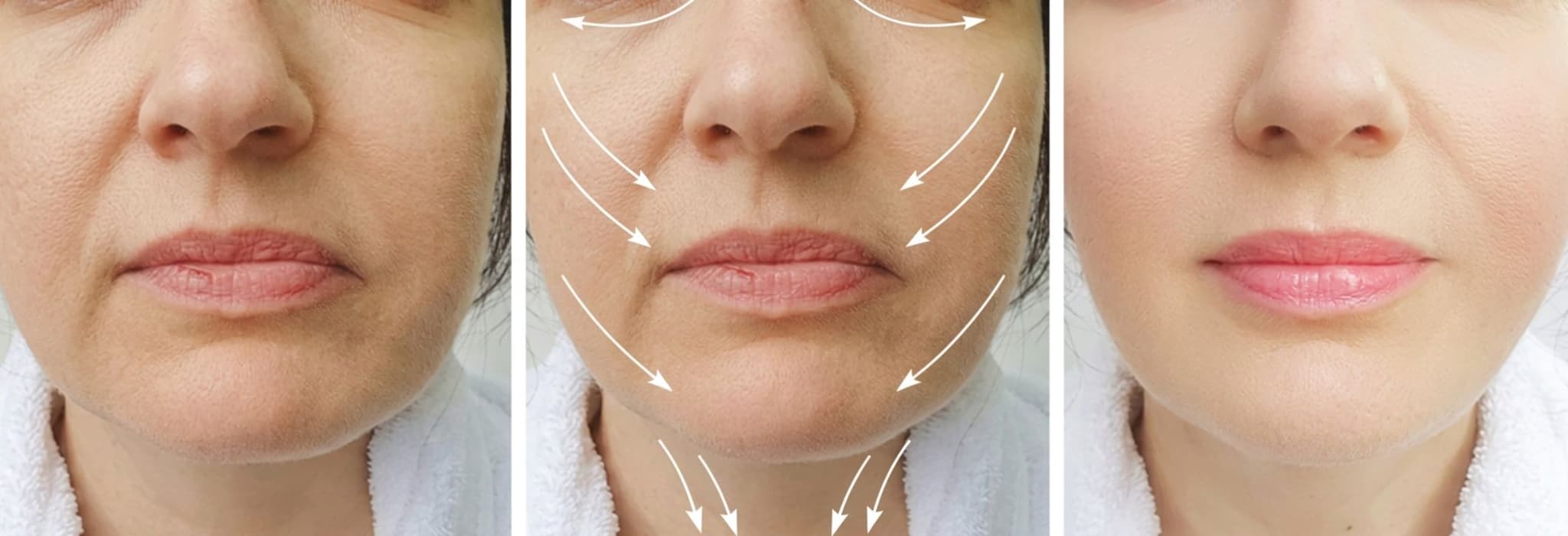
A facelift does not normally "slip" if it is performed properly and healing proceeds normally. With modern facelift techniques, the deeper tissue layers are fixed stably, not only the skin tightened.
However, the following can occur:
- swelling during the healing phase
- scar pull or a sensation of tightness
- renewed skin laxity over time due to significant weight loss and natural aging
- in rare cases uneven results or tissue shifts, mostly due to complications or poor technique
Immediately after surgery the result may look “shifted” due to swelling, but this usually stabilizes within weeks to months. We don’t know how many procedures Kris Jenner had before: after several facelift operations over the years, changes or “shifts” are more likely to occur than after a first procedure.
Why a second facelift often ages differently from the first
The first facelift almost always lasts the longest. We are talking about roughly ten to fifteen years, in individual cases even longer. Longevity depends on the technique, age, the current condition of the connective tissue, weight, lifestyle and baseline findings.
A revision – meaning a second or third lift – can deliver very good results. But it has to be evaluated differently. Skin, subcutis and the SMAS structure thin out over the years. Tissue tension is no longer the same as during the first procedure. A repeat lift therefore usually does not last as long as the first.
Biology can be improved, but not switched off. Revisions require particular expectation management. We make this clear to our patients during consultation.
What a facelift can do
A well-planned facelift can achieve a great deal – especially in the lower face and neck:
- lift sagging cheeks
- reduce deep nasolabial folds and jowls (jawline)
- remove excess skin on the neck
- refine an indistinct chin-neck contour
- significantly soften a tired or sad facial expression
What a facelift cannot do
- e.g. smooth fine lines (crepey wrinkles)
- improve skin quality
- reduce pigment spots
- reduce dark circles
- compensate for volume loss
- tighten the lower lids
- smooth crow’s feet, forehead and the entire eye area
More volume after a facelift?
A facelift primarily tightens sagging tissue, but it does not replace lost volume. With increasing age, the face loses fat tissue, bony support, skin thickness and elasticity. As a result, a face can look empty or hollow. That’s why many surgeons combine a facelift with volume restoration.
Options:
- autologous fat (lipofilling / fat grafting): often harvested from the abdomen or thighs
- hyaluronic acid fillers are not a permanent solution
- biostimulators are very well suited after a facelift, preventatively about 1–2 years afterwards – they stimulate collagen production
- volume is often added at the cheeks, temples, under-eye area, jawline and lip region (too much volume can look unnatural; here it is essential to work precisely and selectively to achieve natural proportions)
Deep plane and SMAS
Around Kris Jenner the discussion about Deep Plane Facelift versus SMAS Facelift flared up again. What sounds like a duel of methods is actually quite simple: in practically all modern facelifts the SMAS layer – the deeper tissue structure – is tightened. This includes the Deep Plane Facelift! When the supporting structure is repositioned sensibly, the face looks natural and the result remains stable.
Statement by Dr. Karl Schuhmann: a facelift is not a standard solution
The Kris Jenner case shows why a facelift always has to be planned individually. It comes down to skin quality, tissue tension, volume distribution, age, previous treatments and the patient’s expectations. Every patient is individual. We need a broad portfolio of techniques, tailored to the current condition and the personal wish.
Dr. Karl Schuhmann, specialist in plastic and aesthetic surgery, met with the world’s leading colleagues for facelift techniques in New York at a multi-day congress in April. With innovative techniques such as the endoscopic facelift, we can complete our portfolio and decide even more precisely which procedure makes sense for whom.
Important: the individual consultation
A facelift starts with a consultation. What really bothers you? What can be improved surgically? Which effects are realistic? Which complementary procedures are suitable for the long-term maintenance of the facelift result and for preventing further age-related changes – for example biostimulators, exosomes or radiofrequency?
These are all important questions that need to be clarified. A 45-year-old face requires different planning than a 65- or 70-year-old face. Revisions also require a different perspective than a first procedure.
Book your consultation appointment here
Back to the Kris Jenner case
Kris Jenner is not a normal benchmark. She lives under the constant scrutiny of cameras, red carpets and in a visual world where every photo is judged. A facelift can do a lot, but it cannot guarantee a permanent “filter” look. Nor does it need to. What is achievable: a natural appearance that once again matches how you feel inside.
Frequently asked questions
How long does a facelift last?
A facelift can last many years; a time frame of about ten years is often cited. Age, skin quality, tissue tension, lifestyle, weight fluctuations and the technique used all play a decisive role. Important: a facelift does not stop the aging process, but the baseline is a different one.
Why does a second facelift often last less long than the first?
With the first facelift, skin, subcutis and the SMAS structure still have more firmness. With a second or third facelift the tissue is older and often thinner. A revision can deliver excellent results, but requires careful planning and realistic expectations on the patient’s side.
Which additional treatments can make sense after a facelift?
After a facelift, complementary procedures can help to further improve skin quality, volume and tissue firmness. Depending on the findings, these include biostimulators, autologous fat, hyaluronic acid, PRF, exosomes, radiofrequency or similar treatments. They don’t replace a lift, but can meaningfully round off the result – particularly when, a few years after surgery, volume loss, thinner skin or decreasing firmness become noticeable again.
Das könnte Sie auch interessieren
Über den Autor
Facharzt für Plastische und Ästhetische Chirurgie & Handchirurg
Mit mehr als 30.000 Eingriffen und mehrjähriger Tätigkeit als Chefarzt führt Dr. Schuhmann seit 2016 als Gründer von artethic® seine Praxen in Düsseldorf und Berlin.