Modern Treatments in Aesthetic Surgery: An Overview and Options

At a glance
- Overview of surgical and non-surgical treatments
- Individual planning for natural, harmonious results
- Focus on safety, patient education and aftercare
- Suitable for the face, breast and body contouring
and coming soon to Düsseldorf and Berlin!
Small incisions, concealed within the hairline. Less visible scarring. Gentle tissue lifting: the endoscopic facelift is currently one of the most exciting developments in modern facial surgery in the United States. Dr. Karl Schuhmann has further refined the technique at the international Facelift Master Course in New York including through collaboration with Dr. Marc Mani from Beverly Hills, who has established an international reputation in the field of endoscopic facelift.
The procedure complements our facelift programmes, particularly in the forehead and temple region, the brows, and as an extension to the modern Deep Plane Facelift. This innovative facelift is of particular interest for younger patients.
What happens during an endoscopic facelift?
During an endoscopic facelift, we make tiny incisions within the hair-bearing scalp. Through these access points, using a fine camera and specialised instruments, underlying tissue structures can be released, lifted and repositioned under direct visualisation.
Excess skin is not removed during this procedure. This is a crucial point. Where skin laxity is more pronounced, other techniques are more appropriate — for example, the Deep Plane Facelift. Here too, scars can be placed discreetly.
For which areas is the endoscopic facelift suitable?
The principal areas of application include:
- Brow lift
- Forehead lift
- Mid-face lifting
- Softening of nasolabial folds
- Correction of early jowling or so-called marionette lines
Following the lift, the facial silhouette appears softer. We lift the tissue along the natural vector directions of the underlying muscles, similar to a vector-based system. The tissue is gently elevated and simultaneously repositioned to a more favourable anatomical position.
When we recommend this technique
Endoscopic lifting is well suited to younger patients. Even those in their thirties or forties. Sometimes it is simply a matter of individual anatomy when certain areas begin to descend: early nasolabial folds, ptotic brows, sagging cheeks, or a heavier-appearing mid-face.
The lift is also an option when hyaluronic acid, NCTF Hyaluron, biostimulators or other minimally invasive treatments are no longer sufficient, yet a conventional facelift would be excessive at this stage.
Equally, in older patients, it is most often combined with other procedures.
Combinations: eyelid surgery, autologous fat and Deep Plane
Depending on the current condition of the skin and the desired outcome, the endoscopic facelift can be combined with upper eyelid surgery, augmentation with autologous fat or hyaluronic acid, with biostimulators, radiofrequency treatments, or a Deep Plane Facelift.
A combination popular among Hollywood celebrities: the Deep Plane Facelift addresses the deeper structures of the mid- and lower face, whilst the endoscopic approach additionally lifts the forehead, temple and brow region.
Our focus is always on a natural overall result!
Procedure and recovery
The operation takes approximately one to three hours depending on the region being treated.
The procedure is performed under general anaesthesia at one of our partner clinics, with an overnight stay. After approximately two to three weeks, patients are ready to return to social activities. As with other surgical procedures, strenuous exercise should be avoided for approximately four weeks.
Further training in New York
In April, Dr. Karl Schuhmann undertook intensive study of modern endoscopic techniques at the international Facelift Master Course in New York.
This course brings together international specialists in facial surgery for collegial exchange on current developments and surgical concepts.
A key focus was minimally invasive endoscopic approaches using the smallest possible access points and natural repositioning of tissue structures — with natural-looking results as the overriding objective.
This treatment is gaining increasing prominence in the United States.
A thorough assessment by a qualified specialist remains essential prior to any procedure
A facelift, including the endoscopic variant, is not a standardised procedure. Where there is significant skin excess and marked laxity, other techniques are more appropriate. What is best suited to you is always determined in a personal consultation.
Modern treatments at our practice
At our practice for Plastic and Aesthetic Surgery, we offer a comprehensive range of treatments — from minimally invasive procedures to complex surgical interventions. The aim of all our treatments is to enhance your natural appearance, harmonise proportions, and achieve a refreshed yet entirely natural result.
The following provides an overview of our most frequently requested treatments and outlines how a typical treatment journey unfolds — from the initial consultation through to aftercare.
Face: lifting, wrinkle treatment and contouring
Facelift and neck lift
A facelift (rhytidectomy) and neck lift are indicated when the skin and soft tissues of the face and neck have lost elasticity over time. Using refined techniques, the descended facial contour is restored without altering natural facial expression. Scars are placed as discreetly as possible within natural skin creases and the hairline.
Typical process:
- Detailed consultation and photographic documentation
- Individual surgical planning (e.g. mini-lift, SMAS lift, neck lift)
- Surgery under twilight sedation or general anaesthesia
- Brief inpatient stay, followed by outpatient follow-up appointments
Wrinkle treatment with Botox® and hyaluronic acid
Dynamic wrinkles (e.g. frown lines, forehead lines, crow's feet) respond very well to treatment with botulinum toxin (Botox®). Static wrinkles and volume loss are frequently corrected using hyaluronic acid fillers. Both treatments are minimally invasive and allow patients to return to their daily routine quickly.
Possible treatment areas:
- Forehead and eye area
- Nasolabial folds and marionette lines
- Lips (lip volume and lip contour)
- Cheek augmentation and jawline contouring
Breast: shape, size and symmetry
Breast augmentation
Breast augmentation with implants is one of the most frequently performed procedures. Depending on the patient's baseline anatomy and desired outcome, round or anatomical implants are used, positioned either above or below the pectoral muscle.
Goals of breast augmentation:
- Harmonious proportions relative to the body
- Correction of asymmetry
- Restoration of volume following pregnancy or weight loss
Breast lift and breast reduction
A breast lift (mastopexy) is suitable for ptotic breasts, commonly following pregnancy or significant weight loss. Where physical symptoms such as neck and back pain are present, a breast reduction may be indicated. Both procedures can be combined with augmentation where required.
Potential benefits:
- Relief of back and shoulder strain
- Improvement in posture
- An aesthetically pleasing, more youthful breast appearance
Treatment pathway — from consultation to aftercare
- Initial consultation: Thorough medical history, clarification of your wishes and expectations, physical examination.
- Individual planning: Selection of the most appropriate technique (e.g. surgical approach, type of filler, implant size), photographic documentation.
- Treatment/surgery: Performed under local anaesthesia, twilight sedation or general anaesthesia — depending on the procedure.
- Immediate aftercare: Review directly following treatment, wound dressing changes, pain management.
- Long-term follow-up: Regular aftercare appointments, documentation of the healing process, adjustment of care recommendations.
Body contouring: liposuction, abdominoplasty and more
Liposuction
Liposuction is suitable for targeted contouring of areas where localised fat deposits persist despite exercise and a healthy diet.
Typical areas:
- Abdomen, hips and waist
- Thighs (saddlebags, inner thighs, knees)
- Upper arms and back
Liposuction is not a substitute for weight loss but serves as a body contouring procedure.
Abdominoplasty (tummy tuck)
Following significant weight fluctuations or pregnancies, the abdominal wall can become lax. An abdominoplasty removes excess skin and tightens the underlying musculature. The procedure is frequently combined with liposuction to achieve a particularly harmonious result.
Our goal is a natural-looking result that suits your individual personality and physique — not a standardised aesthetic ideal.
Non-surgical treatments: a gentle path to a refreshed appearance
Alongside surgical procedures, non-surgical treatments are playing an increasingly important role. They are particularly suited to patients who wish to minimise downtime.
Examples of non-surgical treatments:
- Botox® and filler treatments
- Skin boosters and mesotherapy
- Chemical peels
- Medical-grade skincare for skin rejuvenation
These treatments can be used individually or in combination to achieve the most natural and long-lasting result possible.
Your treatment team — experience, specialisation and personal care
Safety, informed consent and realistic expectations
Prior to every treatment, a thorough discussion of the benefits, limitations and potential risks takes place. We take time to address your questions and jointly determine which approach is most appropriate for you.
Key considerations:
- Realistic assessment of the expected outcome
- Information regarding risks and potential complications
- Individual aftercare and behavioural guidance
We recommend a treatment only when medical indication, personal wishes and patient safety are fully aligned.
Booking an appointment and further information
If you are interested in a treatment, please do not hesitate to arrange a personal consultation. In a confidential discussion, we will clarify which options are suitable for you and create an individualised treatment plan.
Further details on individual treatments can be found in the relevant articles and service descriptions on our website.
Frequently Asked Questions
What is an endoscopic facelift?
In an endoscopic facelift, tiny incisions are made within the hairline, through which a specialist camera and fine instruments are used. Tissue structures can be lifted and repositioned without the need for longer skin incisions. The technique is preferentially used in the forehead, brow and mid-face regions. The endoscopic
Who is suitable for an endoscopic facelift?
The procedure is frequently suitable for the first signs of ageing — when hyaluronic acid or other minimally invasive measures are no longer sufficient, but a conventional facelift does not yet appear necessary. The endoscopic facelift can also be beneficial for older patients, including as part of a combined facelift concept.
Which areas can be treated?
Suitable areas include: ● Descended brows ● Forehead region ● Mid-face ● Early jowling ● Nasolabial folds ● Tired-looking eye area Depending on the clinical findings, we can combine the endoscopic facelift with eyelid tightening, autologous fat transfer, biostimulators, radiofrequency and further treatments.
Where are the scars located?
The incisions are usually concealed within the hairline. This is a particular advantage — once healed, they are barely visible.
Is skin removed during an endoscopic facelift?
Excess skin is not removed. The tissue is tightened using a vector system. Where there is more pronounced skin laxity, modern facelift techniques — which also work with barely visible scars — are more appropriate.
How long is the recovery period?
Most patients are socially presentable again after two to three weeks. Depending on the procedure and type of sport, physical exercise should be paused for approximately four weeks. Individual healing and tissue quality are always the determining factors.
How long does an endoscopic facelift last?
Results can last for many years. Factors such as skin quality, genetic predisposition, significant weight fluctuations, smoking or intense sun exposure all influence the long-term outcome. Can the endoscopic facelift be combined with other procedures? The most appropriate combination depends on the desired outcome. Popular options include: ➔ Upper eyelid surgery ➔ Deep Plane Facelift for older patients ➔ Autologous fat transfer ➔ Biostimulators for skin improvement
How do I find the right treatment for me?
The most suitable treatment is always determined on an individual basis during the consultation. We take into account your wishes, your baseline condition, any pre-existing medical conditions and the desired extent of change. A combination of several methods is often advisable in order to achieve a harmonious overall result.
How much time off will I need after a treatment?
The amount of time off required depends greatly on the type of treatment. Following minimally invasive treatments such as Botox® or hyaluronic acid, you are usually able to resume social activities immediately or the following day. Following surgical procedures such as a facelift, breast surgery or abdominoplasty, you should allow approximately one to three weeks of recovery time before returning to full activity.
What risks are associated with aesthetic treatments?
Every medical treatment carries risks, including swelling, bruising, infection, impaired wound healing or hypersensitivity reactions. Through careful planning, gentle surgical techniques and structured aftercare, risks can be significantly reduced. During the informed consent consultation, we will advise you in detail about all possible complications.
Are the costs covered by health insurance?
Purely aesthetic procedures are generally not covered by statutory health insurance. Where there is a medical indication — for example, very large breasts causing back pain or functional impairment — reimbursement may be considered on an individual basis. We are happy to support you with the necessary medical documentation should this be required.
Über den Autor
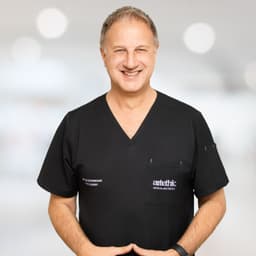
Facharzt für Plastische und Ästhetische Chirurgie & Handchirurg
Mit mehr als 30.000 Eingriffen und mehrjähriger Tätigkeit als Chefarzt führt Dr. Schuhmann seit 2016 als Gründer von artethic® seine Praxen in Düsseldorf und Berlin.