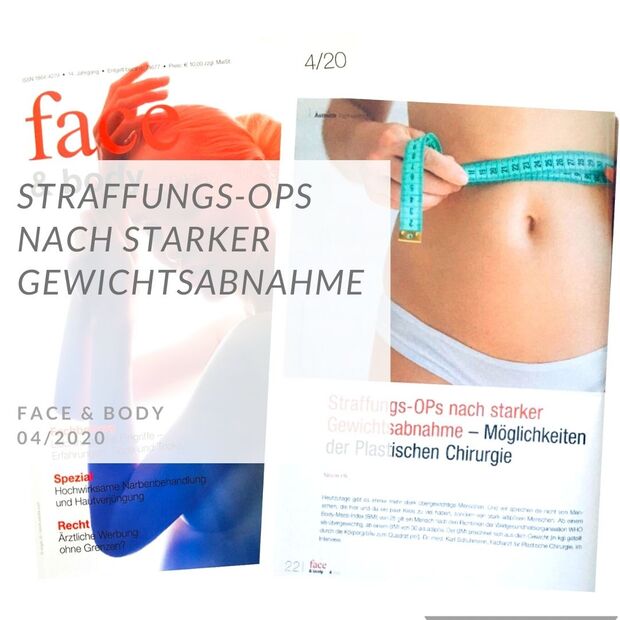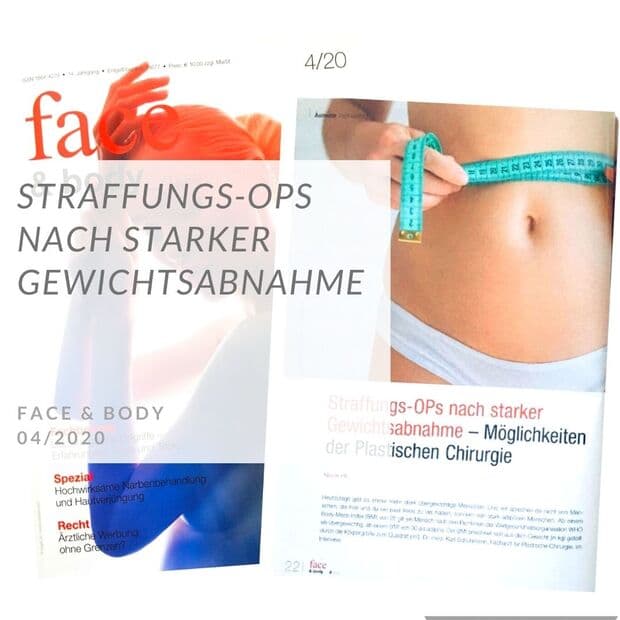
face & body, Magazine for Aesthetics, 04/2020
Nowadays, there are more and more severely overweight people. And we are not talking about people who are a few kilos too heavy here and there, but about severely obese individuals. According to the guidelines of the World Health Organization WHO, a person is considered overweight from a Body Mass Index (BMI) of 25, and obese from a BMI of 30. The BMI is calculated from the weight (in kg) divided by the height squared (m2). Dr. med. Karl Schuhmann, specialist in Plastic Surgery, in an interview.
Overweight – a widespread condition
A quarter of all Germans, around 19 million people, are severely overweight. But many do manage to make the leap to targeted weight loss, often due to severe physical limitations or illnesses. These people then achieve remarkable things by fundamentally changing their diet and their lives in the long term. It is therefore not surprising that weight losses of 40 kg and more are the reward for their efforts.
With very significant weight loss, the body changes drastically. The joy over the weight loss and the pride in the perseverance during the lifestyle change are great. However, weight reduction unfortunately does not only have pleasant consequences. The desired weight has been reached, but excess skin, dimples and sagging tissue remain.
Dr. Schuhmann, you are a specialist in Plastic Surgery. What options does Plastic Surgery offer people after significant weight loss to redefine their body?
Dr. Karl Schuhmann: Significant weight loss after obesity or pregnancies is first and foremost a great success for the people involved. However, due to the often accompanying major changes in the body, those affected not only have an aesthetic problem, but significant weight loss also frequently represents a psychological burden. The renewed physical changes plunge those affected into the next emotional imbalance. Particularly around the abdomen, unsightly fat aprons develop, the skin on the arms and legs becomes slack, and the breasts are also affected.
Plastic Surgery has various treatment options here to restore balance to the new sense of body and to support those affected in taking another step toward a new sense of self-confidence.
Plastic Surgery as a helper for a new body image? Can one put it that way?
Dr. Karl Schuhmann: Yes, one can say that. We have already operated on many patients after significant weight loss. In some cases, multiple procedures were necessary to achieve the desired result. But all patients were of the opinion that these positive changes to their bodies had completed their efforts and exertions. Sentences were said like "Only now do I feel I have reached my goal, like a new person." That naturally makes us as Plastic Surgeons proud and happy when we can give people more quality of life.
Which procedures are particularly requested by patients? And which operations make sense from a medical point of view?
Dr. Karl Schuhmann: Especially for women who have lost a significant amount of weight or also after pregnancies, a breast lift is usually on the wish list alongside an abdominoplasty. The breasts have lost a great deal of volume, as fatty tissue is also lost here. This inevitably leads to sagging and flaccid breasts. A breast lift is advisable here. The breasts are lifted and shaped more firmly. The low-positioned nipples are moved to a higher, more youthful position, without as a rule having to suffer any loss of sensitivity or other restrictions. Since the surgical approach always depends on the individual situation of the breasts to be tightened, three different surgical techniques can be applied in one procedure.
In a breast lift procedure, a periareolar incision around the areola is always made to raise the nipples. A further vertical incision from the lower edge of the nipple to the inframammary fold is sufficient if the breasts are not too severely sagging. In the case of a more significant correction, an additional horizontal incision along the natural breast fold to the side ("L-shaped incision") is necessary; in other cases, an additional incision inward ("T-shaped incision") is made. During the operation, the mammary glands are shaped and lifted, and excess skin is removed so that the breasts regain their firmness. The goal is always to achieve a natural external shape and size of the breast that suits the patient's anatomy. A breast lift, sometimes combined with breast augmentation, is a particularly sensible procedure for women to feel feminine and attractive again.
As already mentioned, an abdominoplasty is in most cases a necessary procedure for both women and men, simply to remove the greatly excess skin on the abdomen. With a full abdominoplasty, excess skin and tissue can be optimally removed. At the same time, abdominal muscles can be tightened, abdominal wall hernias closed, and scars on the lower abdomen, e.g. a caesarean section scar, removed. The full abdominoplasty is the optimal procedure for eliminating unsightly fat aprons on the abdomen. These inevitably form after significant weight reduction. The fat aprons are not only an aesthetic problem for patients, but also medically problematic, as pathogenic germs, fungi and bacteria often develop between the skin folds, and inflammations develop that cannot be avoided even with meticulous care.
What are the most common surgical procedures after significant weight loss?
Dr. Karl Schuhmann: In fact, abdominoplasty and upper arm lift are the most frequently desired operations after significant weight loss. For women, breast lift with breast reconstruction is also added. But the posterior body lift is also in great demand. With the posterior body lift, different areas of the body are tightened. In most cases, a buttock lift and a tightening of the outer thighs are performed in one operation. As we see time and again, it is often necessary to remove excess skin in several operations and to compensate for the volume loss at various points on the body.
In a buttock lift, the skin of the buttocks and the underlying fatty tissue are tightened. From a normal buttock lift, a buttock augmentation with implants to a Brazilian Butt Lift, there are various options depending on the initial findings for correcting a flattened and sagging buttock. There are three criteria that are important for the aesthetics of the buttocks:
- A pronounced V-zone above the buttocks
- An even distribution of buttock volume
- A beautifully shaped Diamond Space at the transition between the buttocks and inner thighs.
The optimal buttock shape can be calculated using the golden ratio. If a vertical and a horizontal line are drawn through the center of the buttocks, four quadrants are created that ideally are approximately equal in size. The classic buttock lift is particularly suitable for people who have lost a lot of weight, as this method allows a large amount of excess skin to be removed. The underlying fatty tissue can also be optimally used to perfectly model the buttocks and give them a beautiful shape again. To do this, the fatty tissue is relocated from outside to inside to give the usually very flat and sagging buttocks a round shape and more volume again. Through the incision in the lumbar region, the excess skin and fatty tissue on the hips are also removed. The tightening of the buttock skin upward also leads to a slight lateral tightening of the thighs.
What options does Plastic Surgery offer with regard to the tightening of legs and arms?
Dr. Karl Schuhmann: What wishes patients have for the Plastic Surgeon depends very much on how much weight has been lost and how old the patient is. Especially young people with excess weight tend to want a complete "total renewal" of all body areas. For older people after weight loss, body contouring and body definition are more in the foreground.
In order to meet these wishes as well, we naturally offer thigh lifts as well as upper arm lifts.
Mini thigh lift
With the mini thigh lift (C-incision), the incision runs from the groin to the gluteal fold. The excess skin and fat is removed, whereby it may sometimes be necessary to dissect down to the thigh muscle. The cutaneous nerves should be spared as much as possible. The wound is closed in several layers; beforehand the tissue is stably fixed. For this purpose, a firm fibrous layer (Scarpa's fascia) in the fatty tissue can be sutured to the periosteum of the pubic bone. This is certainly one of the most important steps in tightening the thighs.
The C-incision is the smallest form of thigh correction for skin laxity of the thighs. It is associated with inconspicuous scars. However, the tightening effect is less compared to the T-lift, as significantly less skin can be removed.
Thigh lift with T-incision
The full thigh lift is performed with a T-incision. The advantage over the C-incision lies in a significantly greater tightening effect. However, an additional vertical scar on the inner side of the thighs must be accepted. The length of this scar depends on the excess skin and also on the patient's wishes. Sometimes even a small scar is sufficient to achieve a significant improvement in tightening.
Upper arm lift
As a result of weight loss and age-related decrease in skin elasticity, excess skin can form on the upper arms. Since the tissue here is very loose, thin and delicate, the sagging skin often cannot be reduced even with diet, exercise or massages.
The incision for the upper arm lift is made on the inner side of the upper arms, from the armpit to a maximum of the elbow joint, depending on the findings. The incisions are made in such a way that later scars are barely visible. Wound closure is achieved with self-dissolving suture material and a special suturing technique to achieve ultra-fine wound sutures.
As with the thigh lift, modern surgical techniques are also used in the upper arm lift to preserve the lymphatic and blood vessels located beneath the skin. This results in less blood loss during the operation and less soft tissue swelling after the operation. This means the patient is active and fit again more quickly after the operation.
Dr. Schuhmann, you are an expert at the Adipositas Zentrum NRW. What experiences have you had there?
Dr. Karl Schuhmann: According to the German Obesity Society, in Germany around two thirds (67%) of men and half (53%) of women are overweight (BMI ≥ 25 kg/m2). A quarter of all adults are severely overweight (obese; BMI ≥30 kg/m2), that is 23% of men and 24% of women. The prevalence of obesity increases with age. It is also evident that people with a lower socioeconomic status are more likely to be affected by obesity. In general, the prevalence has increased over the last two decades, particularly in men and in young adults. Depending on the severity of obesity, life expectancy can be reduced by up to twelve years.
It is therefore important that those affected receive support. They find this support in the obesity centers. With our team of doctors, we offer comprehensive consultations on the topics of nutrition and exercise as well as on the options for gastric reduction. Medical care for existing conditions is also guaranteed, as is psychological support. We as Plastic Surgeons only come into play at the end of a long process and then complete the result. In doing so, we contribute greatly to a new body image and greater self-confidence. That is always wonderful to see!
Thank you very much, Dr. Schuhmann, for the informative conversation.