American and European facelifts compared

Two aesthetic approaches and a reversal of trends?
Beauty, as is well known, lies in the eye of the beholder. The same holds true for facelifts. There is no fixed formula; rather, different techniques reflect varying ideas of rejuvenation. This is particularly fascinating when viewed in an international context: for years, the USA and Europe pursued quite distinct goals in facelift surgery. Yet we are currently observing a compelling convergence – a reversal of trends that is impressively illustrated by prominent examples such as Demi Moore (RTL exclusive feature, January 2026). An overview:
Until now: the US facelift – wrinkle-free and taut
In the USA, patients have traditionally wanted above all one thing: a clearly visible lift and the most complete correction possible of all signs of ageing. Smooth skin, firm contours, no wrinkles. The result was perfectly acceptable if it looked "done". Facelifts were frequently combined with botulinum toxin (smooth forehead) and were regarded as alifestyle statement.
Typical of the US concept: tightening of the mid-face, upper and lower eyelids, forehead, and neck was usually performed in a single procedure. Prominent role models were happy to present themselves as flawless and wrinkle-free.
And in Europe?
Here, a different beauty ideal takes centre stage. Patients desire a fresh, vital appearance, but without visible signs of a facelift. "I want to look younger and more rested, but not as though I've had a lift" is a comment frequently heard during consultations.
The staged approach
Rather than one major procedure, we generally prefer a step-by-step approach. We often begin with tightening of the mid-face and a neck lift. Upper and lower eyelid corrections or a brow lift follow, where desired and appropriate, at a later stage. In this way, the result always remains subtle and natural.
Regenerative treatments as a complement
Regenerative procedures such as biostimulators, skin boosters, or medical radiofrequency (e.g. Quantum RF, Morpheus 8) are becoming ever more important. Theyimprove skin structure from within, deliver lasting rejuvenation, and can also represent an alternative for all those who have not (yet) decided in favour of a full facelift.
The trend towards filler injections is declining
Excessive volume treatments with fillers are increasingly at odds with the desire for a natural appearance. Today we use natural volume – including withautologous fat, micro-fat, or nano-fat– sparingly. Natural volume can also be combined with facelifts, for example following weight loss or the use of weight-loss injections. Another option is smoothing of the eye area and cheeks. Suchcombinationsare one of our specialist areas. Please do not hesitate to speak to us about this.
Conventional hyaluronic acid corrections typically last only a few months. Many patients report: "I have tried a great many things and ultimately invested a great deal of money. Why not simply have a mid-face lift that lasts ten years or more?"
What matters most is your current skin condition and your individual wishes. We discuss these in detail during the consultation appointment.
SMAS technique: the foundation of modern facelifts
Demand for facelifts has risen considerably since 2020, as numerous studies demonstrate. At the same time, more and more people are seeking a long-term natural result. The foundation for this is the SMAS lift. The so-called Superficial Musculo-Aponeurotic System (SMAS) connects skin, muscles, and connective tissue. In a modern facelift, this layer is repositioned and tightened – not merely the uppermost layer of skin.
Specialist congress in New York 2026
Dr. Karl Schuhmann regularly attends international specialist congresses, including one in New York in spring 2026. The focus is on new surgical techniques and the trend towards even more natural results – an approach that is now gaining noticeable importance in the USA as well.
Current trend among US celebrities: greater naturalness
More and more celebrities are opting for subtle tightening and improved skin quality. The emphasis is on collagen stimulation for a fresh, natural appearance – without excessive tightening. Micro-fat treatments, as a complement to facelifts, are also on trend.
Frequently Asked Questions
What is the most important difference between US and European facelifts?
The classic US facelift aims for a clearly visible, taut, and wrinkle-free result – often in a single, extensive procedure. In Europe, and in our practice too, a natural, fresh appearance takes priority, usually achieved through a staged approach and combinations with regenerative procedures.
What does SMAS lift mean?
SMAS stands for "Superficial Musculo-Aponeurotic System" – a connective tissue layer that connects skin, muscles, and underlying structures. In a modern SMAS lift, it is precisely this layer that is repositioned and tightened, not merely the outermost skin. This produces a long-lasting, naturally appearing result.
Why are regenerative treatments gaining in importance?
Procedures such as biostimulators, skin boosters, or medical radiofrequency (Quantum RF, Morpheus 8) improve skin structure from within. They deliver lasting rejuvenation and are a sound option for all those who do not yet wish to undergo a surgical procedure, or who wish to maintain an existing facelift result.
How long does a modern facelift last?
A well-performed SMAS facelift generally lasts ten years or more. Compared with repeatedly recurring hyaluronic acid corrections, which typically last only a few months, a facelift is often the more sustainable long-term choice.
Can a facelift be combined with autologous fat?
Yes, we frequently combine facelifts with autologous fat, micro-fat, or nano-fat transfers, for example following weight loss or to smooth the eye area and cheeks. These combinations are one of our specialist areas.
Über den Autor
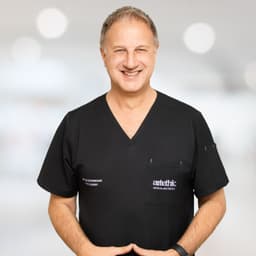
Facharzt für Plastische und Ästhetische Chirurgie & Handchirurg
Mit mehr als 30.000 Eingriffen und mehrjähriger Tätigkeit als Chefarzt führt Dr. Schuhmann seit 2016 als Gründer von artethic® seine Praxen in Düsseldorf und Berlin.