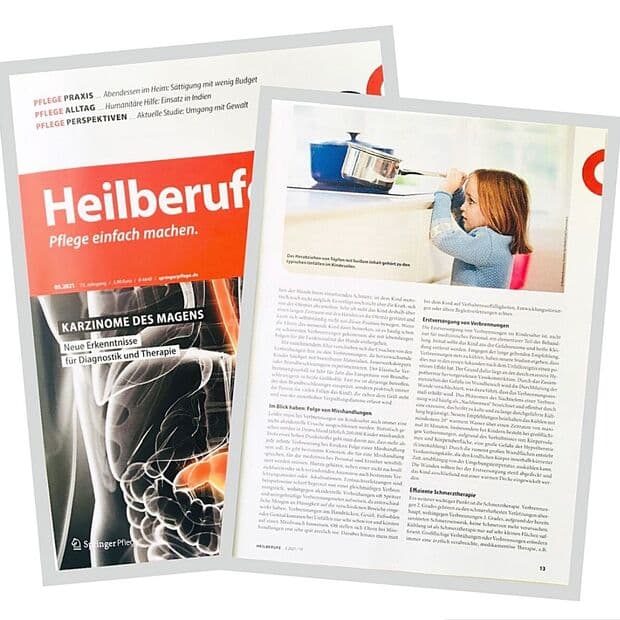
Heilberufe, Springer Pflege, Issue 05.2021
Burns in Children and Adolescents
An 8-year-old boy finds a lighter in the kitchen drawer and takes it outside to experiment with it. It is windy, so he pulls his head down through the collar of his T-shirt to try the lighter sheltered from the wind underneath his shirt. He has never held a lighter before and keeps pressing the red button, so that lighter gas accumulates under his T-shirt. Only on the fifth attempt does he operate the flint wheel, and he goes up in flames.
When I met the boy, he was twelve years old and had already had to endure countless operations, dressing changes, hospital stays and more pain than any single person should have to bear in their entire lifetime. Nevertheless, his chest had become so rigid from the circumferential burn scars that, as he continued to grow, it no longer allowed sufficient breathing movement. An expansion of the scar on the sides of the chest wall with subsequent skin grafting from the thigh was planned. It was the 23rd operation of this kind on this young patient. He would still grow much taller before his growth was complete, and that would mean many more operations.
Preventing Burns and Scalds
These are everyday situations from which a child's life and that of their parents can change fundamentally. The set coffee table, the cosily crackling tiled stove, the barbecue evening with friends. Children are naturally curious and unaware of the dangers of everyday life. It is all the more important to raise awareness of these dangers among adults, whether medical staff and educators, or a concerned mother or a proud father.
The High-Risk Group Is Children Under Four Years of Age
Burns in childhood are among the most traumatic and consequential injuries of all. The lengthy and painful treatment with countless dressing changes, the scars that are often disfiguring and functionally limiting, and the corrective operations that are frequently necessary until adulthood — due to the child's growth — represent a long and life-changing path of suffering for the child and, not least, the entire family. Statistically speaking, more than 30,000 children and adolescents under 15 years of age suffer burns in Germany each year that are severe enough to require medical treatment. Every year, around 6,000 children have to be treated as inpatients for burns, almost a third of them in specialist clinics for severely burned children [1]. Of these, approximately 2/3 of the affected children are under 4 years of age. In summary, children of this age can be described as a high-risk group for burns. The accidents almost always occur in the domestic setting and almost always in the presence of the parents [2].
With a share of 60–85%, scalds represent by far the most common accident mechanism. Typical accidents include pulling down pots with hot contents, or a kettle whose cord hangs within reach of the child [3]. The latter represents such a widespread accident mechanism that the industry now equips kettles with only very short cords. Overturning cups or pots of hot tea or coffee are also very common causes of accidents. It must be borne in mind that a cup of hot tea is sufficient to scald 30% of the body surface area of a small child, which represents a life-threatening situation [1]. Pouring hot inhalation fluid over oneself or poorly sealed hot water bottles are also frequent hazards.
The Household Harbours Great Dangers
The second most common injuries are contact burns from hot hob plates, irons, ovens or heaters. These are particularly common in toddlerhood, when children gain autonomy and are able to touch objects independently. Injuries involving ovens and heaters in particular deserve mention here. Children who are in the process of learning to walk press their palms against the hot surfaces or support themselves with their entire body weight against the hot oven. A reflexive withdrawal of the hands when pain sets in is not yet motorically possible for the child. They do not yet have the strength to push themselves away from the oven door. Very often the child therefore stands for a prolonged period with their hands pressed against the oven door and is unable to move out of this position independently. By the time the parents notice the crying child, the most severe burns have frequently already occurred, which are accompanied by lifelong consequences for the functionality of the hands.
With increasing age, the causes shift from scalds to burns, as growing children more frequently experiment with flammable materials, fireworks or accelerants. The classic burn accident, year after year, is squirting accelerants onto hot barbecue coals. Almost never is the person who squirts the accelerant affected; practically always it is the person (in many cases a child) standing next to the barbecue who is caught by the metre-high deflagration flame.
In Focus: Burns as a Result of Abuse
Unfortunately, a non-accidental cause must always be ruled out in the case of burns in childhood. Statistically speaking, 200,000 children are abused in Germany each year [4]. Despite a high number of unreported cases, it is assumed that more than one in ten burns in children is the result of abuse. There are certain criteria that indicate abuse, to which medical staff and educators must be sensitised [4,5]. These include, in addition to an implausible or changing medical history, certain injury patterns or locations. Immersion injuries, for example, are sharply demarcated with a uniform burn depth, whereas accidental scalds often show splatter marks and irregular burn depths, as different amounts of liquid have acted on different areas. Burns to the back of the hand, buttocks, soles of the feet or genitals are very rare in accidents and may indicate abuse. Parents in cases of abuse often present to a doctor very late. In addition, one must watch for behavioural abnormalities, developmental disorders or older accompanying injuries in the child.
Initial Management of Burns
The initial management of burns in childhood represents an elementary part of treatment, not only for medical personnel. Initially, the child should be removed from the danger zone and hot clothing should be removed. Contrary to the long-standing recommendation to always cool burns, more recent studies have shown that this only has a positive effect in the first seconds after the accident [6]. The reason for this lies in the vasoconstriction caused by excessive hypothermia. The contraction of the vessels in the wound area worsens blood supply to the wound, which leads to an increase in the extent of the burn. The phenomenon of a burn deepening is often referred to clinically as "afterburning" and is apparently promoted by excessive cooling, i.e. cooling that is too cold and carried out for too long. More recent recommendations include cooling with water of at least 20°C for a maximum of 10 minutes [7]. Particularly in children with large-area burns, there is a significant risk of hypothermia due to the ratio of body volume to body surface area. The mostly large wound surfaces produce evaporative cooling, which can cool the child's body within a very short time, regardless of the ambient temperature. The wounds should therefore be covered sterilly during initial management and the child should subsequently be wrapped in a warm blanket.
Effective Pain Management
Another important point is pain management. Second-degree burns are among the most painful injuries of all, whereas third-degree burns no longer cause pain due to the already destroyed pain receptors [8]. Cooling is only sufficient as pain therapy on very small areas. Large-area scalds or burns always require medically administered pharmacological therapy, e.g. using ketamine and midazolam administered nasally via a spray applicator, intravenously or if necessary intraosseously.
To assess the extent of a burn, it is important to be able to roughly estimate the affected body surface area. The well-known "rule of nines", in which the head and arms are each assigned 9% and the legs as well as the back and chest with abdomen each 18% of the body surface area, does not apply to children under 15 years of age. The Lund and Browder classification takes into account the different ratio of volume to surface area in children, but is not very practical clinically, particularly for non-specialist personnel. A practical method for determining the affected surface area is the "palm rule". Here, the patient's palm, from the wrist to the fingertips, counts as 1% of the body surface area. The burned body surface area can thus be determined relatively reliably and without the use of formulas or measuring devices by counting the approximate number of the patient's palms that could be placed in the burned area. The body surface area affected by the burn is essential for later intensive care therapy for calculating the approximate fluid requirements. From an affected body surface area of just 10%, a so-called burn disease must be anticipated in the course of treatment. In this condition, generalised oedema formation leads to an intravascular volume loss, which can result in hypovolaemic shock. The key element of therapy in this phase is intravascular volume replacement, which is roughly calculated using the Baxter-Parkland formula:
4 x body weight x % proportion of burned body surface area = ml volume requirement in the first 24 hours.
Even if intensive care treatment in these cases should be reserved for a specialist clinic, knowledge of the relationship between affected body surface area and fluid requirements is also important in initial management. If the extent of the burn exceeds 10% of the body surface area and the journey to the burns centre takes more than 30 minutes, infusion therapy must be commenced before arrival at the hospital in order to prevent life-threatening shock.
The burn depth is also of central importance for assessing the severity of the injury. Burns are classified into grades 1, 2a, 2b, 3 and 4. Grade 1 is accompanied by pain and redness and generally heals spontaneously within 48 to 72 hours. Grade 2a involves blister formation and severe pain, but heals without scarring after 7 to 14 days. With grade 2b burns, the dermis is also affected and the pain is already somewhat less pronounced. Clinically, a white blister base is evident along with absent capillary refill, i.e. when pressure is applied to the wound surface, there is no return of blood to the outer skin layers. Spontaneous healing is only possible in small areas in these cases and is accompanied by scar formation. With third-degree burns, spontaneous healing is no longer possible; debridement of the necrosis with subsequent split-thickness skin grafting is necessary. Pain occurs only to a very limited extent with third-degree burns. Fourth-degree burns refer to cases of charring in which muscles, tendons or bones may also be affected.
Assessment of the injury present is so important because the criteria for admitting the child to a burns centre must be weighed up right from the outset. The following injuries should always be treated in a specialist clinic:
- all children under one year of age
- second-degree burns of more than 5% body surface area
- all third-degree burns
- inhalation trauma from smoke or toxic gases (including suspected cases)
- electrical burns
- burns to the face, hands, feet, armpits, anogenital area or over major joints
- any suspicion of child abuse
In summary, burns in childhood are a traumatic event for the children themselves and not infrequently for the parents as well. Through education and prevention, a large proportion of injuries could potentially be avoided. Organisations such as "Paulinchen e.V." have been tirelessly working towards this for many years. However, when an accident does occur, prompt and correct treatment is of the utmost importance for the child's later outcomes. When in doubt, a doctor should always be consulted without delay and admission to a specialist clinic should also be considered if necessary. Unfortunately, particularly in children, the possibility of abuse must not be excluded from the outset, and suspected cases should also be reported and treated accordingly in specialised centres.
Dr. Colja Cordes, Senior Physician at the Department of Plastic/Aesthetic Surgery & Hand Surgery
Augusta Kliniken Bochum Hattingen